
Trump Is Being “Mogged” In China
By: Sam Massey
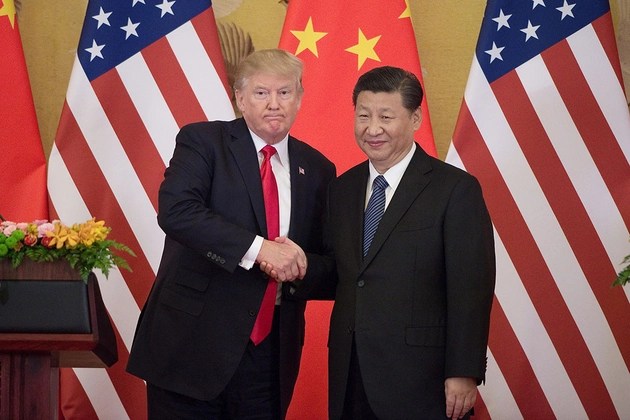
Donald Trump arrived in Beijing on May 13th for a three-day state visit that, whatever its diplomatic intentions, produced an unmistakable visual and symbolic dynamic: China was in charge. From the moment Air Force One touched down at Beijing Capital International Airport and Trump was greeted by a military honor guard, a military band, and roughly 300 students waving coordinated flags, the choreography was entirely Beijing’s. Xi Jinping received Trump at the Great Hall of the People with the full weight of a civilization-state that has been staging these moments for thousands of years. Trump called it “a magnificent welcome like no other.” He was not wrong, and that was precisely the point.
The substance of the talks reinforced the optics. Meetings originally scheduled for one hour ran two, with Xi setting the thematic frame from his opening remarks, invoking the Thucydides trap, referencing a “transformation not seen in a century,” and positioning China as the stable, forward-looking partner in a turbulent world. Trump responded by telling Xi “you’re a great leader” and “it’s an honor to be your friend.” Xi walked Trump through Zhongnanhai, the innermost compound of Chinese Communist Party power, where he casually noted that Putin had visited several times. He pointed out a 490-year-old tree in the garden and mentioned that others on the grounds had lived past a thousand years. The message, delivered with total composure, was that China has been here before and will be here long after any particular American administration.
The business delegation Trump brought along told its own story. Elon Musk, Jensen Huang, Tim Cook, and the CEOs of Goldman Sachs, BlackRock, Citigroup, and Boeing all made the trip, several of them flying over on Air Force One. Xi met with them separately and told them China’s doors would only open wider. American’s dominant private sector, in other words, came to Beijing to ask for access. China granted an audience. Trump announced a Boeing order of 200 planes, framing it as a win, though industry had been expecting closer to 500. The NVIDIA chip export approvals for Chinese tech giants including Alibaba, Tencent, and ByteDance represented a significant concession from Washington dressed up as a negotiated outcome.
The visit to the Temple of Heaven, the state banquet at the Golden Room, the rose garden stroll at Zhongnanhai: every setting had been chosen to communicate permanence, depth, and civilizational weight. The banquet menu ran from Peking duck to crispy beef to tiramisu, the military band played six Chinese songs and six American ones, and the evening closed with Trump’s favorite song, the Village People’s Y.M.C.A., blasting inside one of the most historically significant rooms in China. That detail is either a gracious gesture or the most polite form of condescension in modern diplomatic history, and it probably does not matter which, because China got exactly the imagery it wanted either way.
Trump left Beijing having secured some trade language, a Boeing announcement, and a promise from Xi to visit Washington in September. China left the visit having hosted a sitting American president inside Zhongnanhai for the first time under Xi, extracted chip access for its leading technology companies, received explicit signals that the United States is not backing Taiwan independence, and watched Trump publicly call Xi a great leader on Chinese soil in front of a global audience. One side came to Beijing to do business while the other side was already comfortable staying home.
Check out Gambit Forecaster’s most recent election forecast.